

Hair loss can affect men at different stages of life, and male pattern hair loss is one of the most common causes. As the hairline gradually recedes or the hair on the crown becomes thinner, many men look for treatments that can support existing hair without immediately turning to surgical procedures.
One option that has gained attention is platelet rich plasma therapy, commonly known as PRP. PRP for men uses a concentrated portion of the patient’s own blood to deliver platelets and growth factors to the scalp. The treatment is minimally invasive and is often considered for men with early or moderate pattern hair loss.
Research suggests that PRP may improve hair density and reduce hair loss in some patients, although results can vary and the evidence is still evolving. A 2024 systematic review focusing specifically on male androgenetic alopecia found potential benefits, while also noting considerable variation between studies and treatment protocols. Understanding how the treatment works, who may benefit from it and what results to expect can help men make a more informed decision.
What Is PRP for Men?
PRP for men is a non surgical treatment that uses a patient’s own blood to prepare platelet rich plasma for injection into areas of the scalp affected by hair thinning. A small amount of blood is first drawn and processed in a centrifuge. This separates the plasma and concentrates the platelets. The resulting PRP contains various growth factors that may support the activity of hair follicles when injected into the scalp.
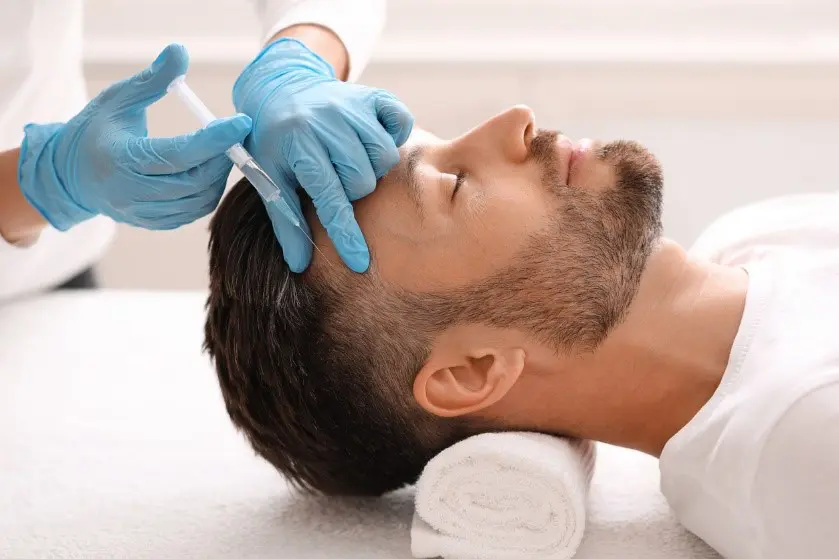
PRP is most commonly considered for androgenetic alopecia, also called male pattern hair loss. This condition is influenced by genetic and hormonal factors and commonly affects the frontal hairline, temples and crown. The treatment does not create completely new hair follicles. Instead, the aim is generally to support existing follicles that have become weakened or miniaturized.
How Does PRP For Men Help With Hair Loss ?
The exact biological mechanisms behind PRP are still being investigated. Platelets contain growth factors and other signaling substances that may influence tissue repair and cellular activity. When PRP is injected around affected hair follicles, these factors may help create an environment that supports follicular activity. Some studies have reported improvements in hair density and hair count following treatment.
Research specifically involving men has shown encouraging findings. A systematic review of studies involving male androgenetic alopecia found that several trials reported statistically significant improvements in hair density or hair count after PRP treatment. However, the researchers also highlighted differences in preparation methods, treatment schedules and study quality. This means PRP can be a useful treatment option for selected patients, but it should not be presented as a guaranteed cure for male pattern baldness.
Who Can Benefit From PRP for Men?
PRP is generally more suitable when viable hair follicles are still present in the areas being treated. Men with early or moderate hair thinning may therefore be better candidates than those with extensive areas of completely smooth baldness.
A consultation should begin with identifying the actual cause of hair loss. Male pattern hair loss is common, but not every type of hair loss has the same cause or requires the same treatment. A best plastic surgeon in Dubai may assess the pattern of thinning, the condition of the scalp, the quality of existing hair and the progression of hair loss before recommending PRP.
PRP may be considered when a man:
• Has early or moderate male pattern hair loss
• Has thinning hair but still has active follicles in the affected areas
• Wants a minimally invasive treatment
• Is looking for an option that can complement other hair restoration approaches
• Has realistic expectations about gradual improvement
Men with sudden or unexplained hair loss should be evaluated before starting treatment. Hair loss caused by nutritional deficiencies, certain medical conditions, medications or inflammatory scalp disorders may require treatment of the underlying cause instead.
PRP For Men: What Happens During Treatment?
The procedure is relatively straightforward and usually takes place in a clinical setting. First, a small amount of blood is collected from the patient. The sample is then processed to separate the platelet rich plasma from other blood components. The prepared PRP is subsequently injected into selected areas of the scalp. A topical or local anesthetic may be used to make the injections more comfortable, depending on the treatment approach and the patient’s preference.
The injections are typically distributed across areas where hair is thinning. The entire process can usually be completed during an outpatient appointment, without the need for general anesthesia or a surgical incision. Because the PRP comes from the patient’s own blood, it is considered an autologous treatment. However, that does not mean complications are impossible. Temporary tenderness, swelling, redness or discomfort can occur after injections.
How Many PRP Sessions Are Needed?
PRP is usually performed as a series of treatments rather than as a single session. There is no universally accepted protocol because studies have used different platelet concentrations, preparation methods, injection techniques and treatment intervals. The American Academy of Dermatology notes that some dermatologists use monthly treatments during the first three months, followed by maintenance treatments every few months.
A treatment plan should therefore be based on the patient’s degree of hair loss, response to treatment and overall goals rather than following a fixed schedule advertised as suitable for everyone. Maintenance treatment may also be recommended when improvements are achieved, particularly because male pattern hair loss is a continuing process.
When Will Men See PRP Results?
PRP does not produce an immediate change in hair growth. Hair follicles operate according to a natural growth cycle, so improvements generally take time. Some men may notice reduced shedding before they see obvious changes in hair density. With continued treatment, improvements in the appearance and density of existing hair may become more noticeable over the following months.
Clinical studies have reported improvements in hair density at several months after treatment. However, the degree of improvement varies considerably between individuals. A 2024 meta analysis found evidence that PRP can increase hair density in androgenetic alopecia, but also described the overall evidence as low quality because of substantial differences between studies. This is why before and after photographs, clinical examination and appropriate follow up can be more useful than expecting a specific result within a fixed number of weeks.
PRP for Men vs Hair Transplantation
PRP and hair transplantation address hair loss in very different ways. PRP is a non surgical treatment intended to support existing hair follicles. It does not move hair follicles from one area of the scalp to another. Hair transplantation, on the other hand, involves surgically moving follicles from a donor area to areas affected by significant hair loss. It can therefore be considered when a patient needs actual redistribution of hair follicles.
For some men, PRP may be considered before or alongside a hair transplant. The American Academy of Dermatology notes that dermatologists may use PRP alone or before a hair transplant in selected patients. The right choice depends on the pattern and extent of hair loss, donor hair availability, existing follicle health and the patient’s expectations.
Is PRP for Men Safe?
PRP for men is generally considered minimally invasive, and because the material is prepared from the patient’s own blood, allergic reactions to the injected plasma are not the primary concern. Nevertheless, injections can cause temporary discomfort, redness, swelling or tenderness. There can also be a small risk of infection, bleeding or bruising.
The quality of treatment also depends on appropriate patient assessment, sterile technique, PRP preparation and injection technique. A qualified medical professional should determine whether PRP for men is appropriate rather than treating every form of hair loss with the same protocol.
It is equally important to understand that PRP for men is not a guaranteed solution for baldness. Existing research is encouraging, but studies have used different methods and have produced variable outcomes. A 2025 systematic review and meta analysis of 43 randomized controlled trials found evidence supporting improvements in hair density and reduced hair loss, while also highlighting differences in PRP preparation and study protocols.
Can PRP Be Combined With Other Hair Loss Treatments?
Depending on the cause and severity of hair loss, PRP may be considered as part of a broader treatment plan. For men with androgenetic alopecia, established medical treatments may also be discussed. In some cases, PRP may complement rather than replace these approaches.
A 2026 systematic review comparing PRP with topical minoxidil found no significant difference between the two treatments for some measures of hair density, while patient satisfaction and other outcomes varied. This reinforces the importance of individualized treatment rather than assuming that one option is universally superior. A doctor may therefore recommend one treatment or a combination depending on the patient’s diagnosis, age, progression of hair loss and response to previous treatment.
PRP For Men: What Should Men Expect?
The most important expectation is gradual and potentially modest improvement rather than an instant transformation. PRP for men may help reduce hair shedding and improve the density or appearance of existing hair in suitable patients. It is generally more useful when follicles are still present and capable of responding to treatment.
It is not designed to restore a completely bald area with new follicles. The response can also differ from one person to another, which is why an assessment before treatment is important. Men considering PRP should discuss realistic goals, the likely treatment schedule, maintenance requirements and alternative options during their consultation.
PRP For Men: Take the Next Step with an Expert Consultation
If you are experiencing thinning hair or a receding hairline, the first step should be understanding why the hair loss is occurring. PRP for men may be a suitable option for some patients, particularly when thinning is identified early and viable follicles remain.
A professional consultation can help assess your scalp and hair loss pattern and determine whether PRP, medication, hair transplantation or another approach is more appropriate for your individual needs. Rather than choosing a treatment based only on advertised results, a personalized assessment can help you understand what is realistically achievable and develop a treatment plan that matches your hair restoration goals.
Frequently Asked Questions About PRP For Men
Is PRP effective for men’s hair loss?
Research suggests that PRP may improve hair density and reduce hair loss in some men with androgenetic alopecia. However, results vary and current evidence has limitations, including differences between treatment protocols and study designs.
How long does PRP for men take to work?
PRP does not produce immediate hair growth. Changes generally develop gradually over several months, and multiple treatment sessions may be recommended.
Is PRP for Men painful?
PRP involves multiple small injections into the scalp, so some discomfort can occur. A topical or local anesthetic may be used to improve comfort during treatment.
Can PRP regrow hair on a completely bald scalp?
PRP is primarily intended to support existing or weakened hair follicles. It cannot create completely new hair follicles in an area where follicles are no longer present.
How long do PRP for Men results last?
The duration of results varies between patients. Because male pattern hair loss can continue to progress, some patients may require maintenance treatments or additional hair loss management.
Can PRP for Men replace a hair transplant?
Not always. PRP and hair transplantation serve different purposes. PRP supports existing follicles, while transplantation moves follicles from a donor area to areas requiring greater coverage. Some patients may benefit from combining approaches.
Is PRP suitable for every man with hair loss?
No. The cause and pattern of hair loss should be assessed first. PRP may be less appropriate when hair loss is caused by conditions that require different medical treatment or when extensive areas have lost viable follicles.